The Science of Gray Hair Reversal: Why Your First White Hairs May Not Be Permanent
Emerging research shows that early graying is not always permanent — stress-induced depigmentation can reverse when the trigger is removed. Understanding the biology of melanocyte stem cells and oxidative stress opens a new path to targeted intervention.
ELUMÉ™ Editorial
 Hover to reveal
For generations, we have been told that gray hair is a one-way street — a permanent marker of ageing that can only be covered, never corrected. But emerging science is challenging this assumption in ways that matter for anyone who has noticed their first white strands appearing earlier than expected.
What if the first signs of graying aren't permanent? What if they're a biological signal — one that, with the right intervention, can be answered?
The Biology of Hair Colour: What Creates — and Destroys — Pigment
Every strand of hair is coloured by a precise biochemical pipeline operating inside each follicle. Melanocyte stem cells (McSCs) differentiate into mature melanocytes, which activate the copper-dependent enzyme tyrosinase to convert the amino acid tyrosine into melanin — the pigment that gives hair its colour. That melanin is then transferred to the keratinocytes that form the growing hair shaft.
Two types of melanin determine shade. Eumelanin produces brown-black pigment and dominates in dark hair. Pheomelanin produces red-yellow tones and is more prevalent in lighter hair. Most hair colour is a blend of both. Gray hair occurs when this pipeline breaks down — not because the follicle stops growing, but because melanin production falters at one or more of these stages.
The five-stage pigmentation pipeline — and the three points at which it breaks down in graying hair.
The Groundbreaking Discovery: Gray Hair Can Reverse Naturally
In 2021, a landmark study published in eLife shattered the assumption that graying is irreversible (Rosenberg AM et al., 2021 — PMID: 34155974). Researchers mapped pigmentation patterns along individual hair shafts with high resolution — creating a biological timeline of colour changes preserved in the growing strand. By correlating these patterns with self-reported life events, they tracked precisely when and why individual hairs changed colour.
What they found was unexpected. Natural reversal of gray or white hairs — spontaneous return to pigmentation — was observed across multiple sexes, ethnicities, age groups spanning the twenties through fifties, and different body regions. Reversal was not an anomaly. It was a pattern.
One particularly striking case: a 30-year-old participant who experienced rapid depigmentation over one to two months of self-reported profound perceived stress, followed by complete reversal — 103% pigmentation recovery — once the stress was alleviated. The timeline mapped precisely onto the stress episode, preserved in the hair shaft like a biological diary.
The molecular data confirmed the mechanism. In gray segments of the same hair shafts, mitochondrial proteins were upregulated — indicating a metabolic shift — antioxidant defence proteins were elevated in apparent response to oxidative stress, and melanogenesis enzymes were markedly downregulated. The follicle was under stress; melanin production was the first casualty.
The hair shaft doesn't lie. It records what happened to the follicle — when, and in response to what.
The Threshold Model: Why Some Graying Reverses and Some Does Not
The researchers proposed a threshold model: each follicle's pigmentary capacity exists on a continuum, not a binary switch. When cumulative stressors push the follicle below a functional threshold, pigmentation fails. When those stressors are removed before permanent stem cell loss occurs, recovery is possible.
This is the critical distinction. Early graying — driven primarily by stress and oxidative burden, before melanocyte stem cells are significantly depleted — exists within a window of reversibility. Late-stage graying, where the McSC reservoir itself has been exhausted, does not. The window is real, but it is not unlimited.
The threshold model — pigmentation can recover from stress-driven dips, but only while the melanocyte stem cell reservoir remains intact.
Oxidative Stress: The Primary Driver of Early Gray
Melanocytes are unusually vulnerable to oxidative damage. The melanin synthesis process itself generates reactive oxygen species (ROS) as a byproduct — meaning the act of producing pigment creates pressure on the cells responsible for it. When systemic antioxidant defences are overwhelmed, this burden tips the melanocyte toward dysfunction and eventually toward the programmed cell death that permanently ends its contribution to colour.
Hydrogen peroxide accumulation is the most direct mechanism. The scalp in graying hair shows elevated H₂O₂, which oxidises melanocytes and bleaches melanin already present in the shaft from within. The enzyme catalase, which neutralises H₂O₂, declines with age — creating a self-reinforcing cycle: less catalase means more H₂O₂, which means more damage to the very cells responsible for colour.
Addressing this cycle requires intervention at the follicle level — not just systemic antioxidant support, but targeted delivery of compounds that restore the local oxidative environment in which melanocytes can survive and function.
Inside ELUMÉ™ Pigment Restore: The Active Ingredients
The ELUMÉ™ Pigment Restore Hair Darkening Tonic is formulated around a multi-target approach to the graying cascade — addressing melanogenesis reactivation, stem cell protection, oxidative burden reduction, enzyme cofactor supply, and follicle cellular health simultaneously. Each active targets a mechanism that the others cannot reach.
Four actives targeting four distinct mechanisms of the graying cascade — together addressing what no single ingredient can.
Darkenyl™ — Melanogenesis Reactivation
Darkenyl™ (dihydroxypropyl bis-palmitoyl glutamide) is a patented active developed specifically to reactivate the melanin production pipeline. It works by stimulating tyrosinase activity — the rate-limiting enzyme in melanin synthesis — and promoting the differentiation of melanocyte stem cells into active, pigment-producing melanocytes. Research on Darkenyl™ demonstrates measurable increases in melanin synthesis and improvement in pigmentation transfer to the keratinocytes that form the hair shaft.
This is a direct intervention at the production stage of the pipeline. Where oxidative damage and stress have suppressed melanogenesis enzyme activity, Darkenyl™ works to restore it — not by bypassing the biology, but by providing the molecular signal that tells dormant melanocytes to resume their function.
Greyverse™ — Melanocyte Stem Cell Protection
The McSC reservoir is the long-term determinant of hair colour. Once these stem cells are depleted, pigmentation cannot resume — which is why protecting them before depletion is categorically more valuable than attempting restoration after the fact.
Greyverse™ is a patented peptide complex formulated to protect melanocyte stem cells from the oxidative stress and premature senescence that accelerate their depletion. It targets the oxidative burden in the follicle environment directly — reducing the molecular damage that triggers stem cell loss. In clinical evaluation, Greyverse™ has shown efficacy in delaying the onset of visible graying and supporting the viability of the McSC population over time.
Silver-Free™ — Hydrogen Peroxide Neutralisation
Silver-Free™ addresses the H₂O₂ accumulation that bleaches melanin from within the hair shaft and damages the melanocytes responsible for producing it. It functions through a catalase-mimicking mechanism — providing the enzymatic activity that declines with age, neutralising hydrogen peroxide at the follicle level before it oxidises melanin or triggers melanocyte apoptosis.
This is a root-cause intervention for the bleaching mechanism. Topical delivery is critical here: systemic antioxidants reach the scalp in limited concentrations, and H₂O₂ accumulation is a local phenomenon. Silver-Free™ is formulated for scalp absorption to address the problem where it occurs.
GHK-Cu (Copper Peptide) — Enzyme Cofactor and Follicle Support
Tyrosinase is a copper-dependent enzyme — copper is not simply a cofactor, it is structurally essential to its function. GHK-Cu (glycyl-L-histidyl-L-lysine copper) delivers bioavailable copper directly to the follicle environment, supporting tyrosinase activity alongside Darkenyl™'s enzyme stimulation. Without adequate copper, the enzyme cannot function regardless of how well it is activated.
GHK-Cu also supports the structural scaffolding of the follicle — stimulating collagen and elastin synthesis in the dermal sheath, activating matrix metalloproteinases for extracellular matrix remodelling, and demonstrating the ability to enlarge follicle size in research. It creates a healthier physical environment in which both melanocytes and the structural cells of the follicle can function optimally.
PDRN — Cellular Repair and Anti-Inflammatory Foundation
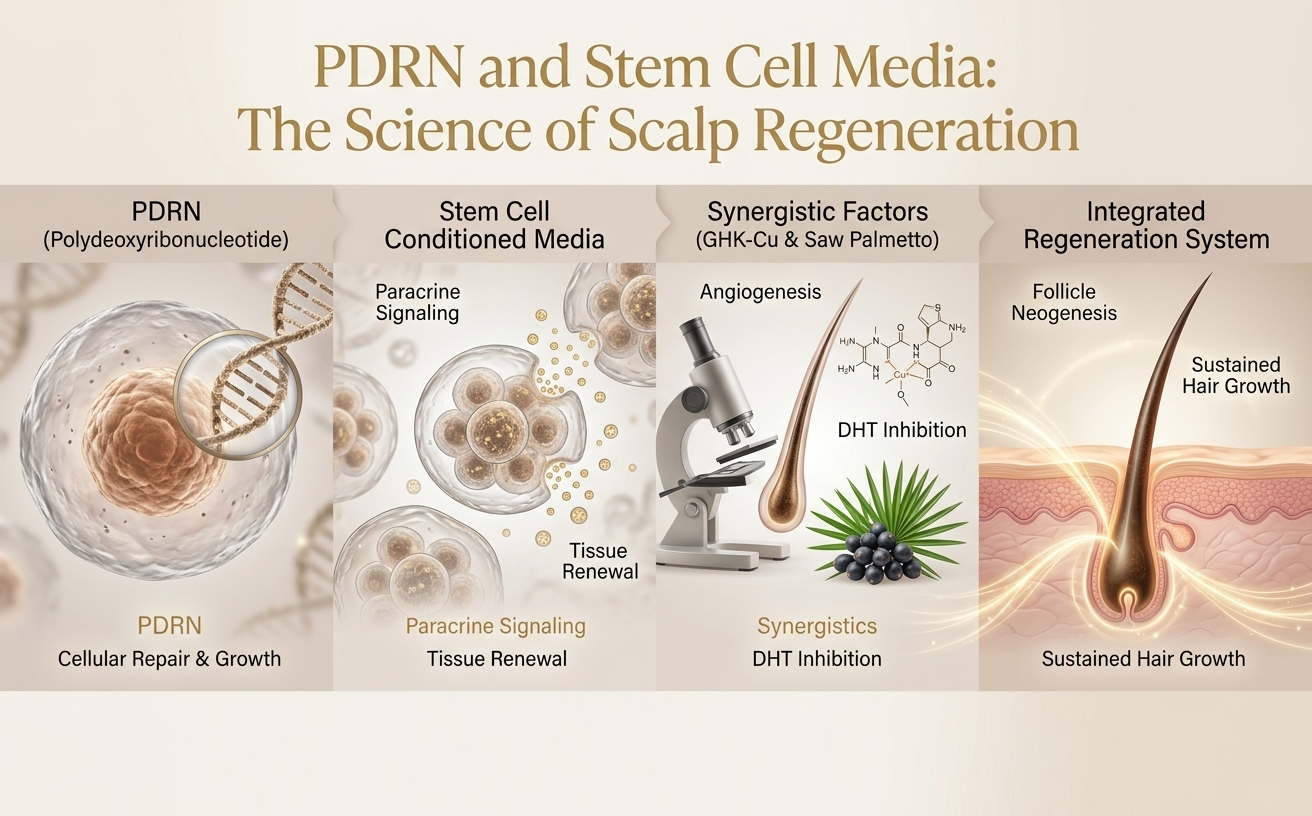
PDRN (Polydeoxyribonucleotide) supports the graying formula through its A2A receptor mechanism — reducing TNF-α, an inflammatory cytokine that actively disrupts melanocyte function and accelerates stem cell depletion. Chronic scalp inflammation is an underappreciated driver of early graying, and PDRN's anti-inflammatory action addresses this pathway directly.
PDRN also provides nucleotide substrate for cellular repair — supporting the DNA repair capacity of melanocytes under oxidative stress, and stimulating microcirculation to improve the delivery of nutrients and growth factors to the pigmentary unit.
Redensyl and Stem Cell Media — Follicle Stem Cell Activation
Redensyl activates the outer root sheath cells (ORSc) of the hair follicle through its active compound DHQG (dihydroquercetin-glucoside), promoting stem cell division and follicle entry into the anagen growth phase. This supports the broader follicle health context in which melanocyte stem cell populations are maintained.
Stem Cell Media delivers the concentrated growth factor secretome — including VEGF, HGF, and IGF-pathway signals — that the follicle environment requires for healthy cell cycling and regeneration. Together, these actives ensure the follicle as a whole is supported, not just the pigmentation unit in isolation.
The Honest Limits of What Science Currently Supports
The 2021 eLife study was observational, not interventional. It documented that reversal occurs naturally and correlated it with stress — it did not test whether specific actives can reliably reproduce or accelerate that reversal. Research on the individual ingredients in Pigment Restore is supported by mechanistic and clinical data.
What the evidence does support clearly is a mechanistic framework: oxidative stress, inflammatory burden, stem cell depletion, and enzyme suppression are the primary drivers of early graying — and each of those drivers has identifiable, targetable biology. The earlier that biology is addressed, the more meaningful the options remain.
Graying is not simply ageing. It is biology responding to environment — and like most biological processes, consistency over time is what the biology actually requires.
Gray hair is not a verdict. For many people, in its early stages, it is a conversation — one the follicle is still willing to have.
Explore ELUMÉ™ Pigment Restore — the multi-active tonic formulated to address the graying cascade at every stage.
Explore the full ELUMÉ™ Follicle Longevity range.
This article is for educational and informational purposes only and does not constitute medical advice. The research cited is observational or mechanistic in nature and does not constitute clinical evidence that any product can reverse or prevent gray hair. If you have concerns about hair or scalp health, consult a qualified dermatologist or trichologist. ELUMÉ™ products are cosmetics, not medicines, and are not intended to diagnose, treat, cure, or prevent any disease or medical condition.