
The 90-Day Cellular Reset: What Happens When You Commit to Longevity Daily
A biology-backed phase-by-phase guide to what your cells are actually doing across 90 days of NAD+ restoration — and when you can realistically expect to feel the difference.
ELUMÉ™ Editorial
Ageing is not a switch. It is a dial — one that has been quietly turning in the wrong direction for years, so gradually that most people mistake the drift for destiny.
The question is not whether cellular decline can be slowed. The research is clear that it can. The question most people ask — and rarely get a precise answer to — is: how long does it actually take to feel the difference?
This article answers that question. Not with marketing optimism, but with biology.
Why 90 days?
The 90-day window is not arbitrary. It maps onto three distinct biological timeframes that govern cellular renewal:
- Days 1–30: Initial cellular uptake, early mitochondrial response, and the first measurable shifts in NAD+ levels.
- Days 30–60: Deeper sirtuin activation, senescent cell clearance, and emerging metabolic changes that begin to surface as noticeable improvements.
- Days 60–90: Cumulative effects compound — optimised cellular metabolism, improved resilience, and the systemic integration that clinical trials call significant change.
Most clinical studies showing measurable outcomes in NAD+ precursor research use 8–12 week observation periods. This is not coincidence — it is the timeframe biology actually requires.
What to expect, phase by phase
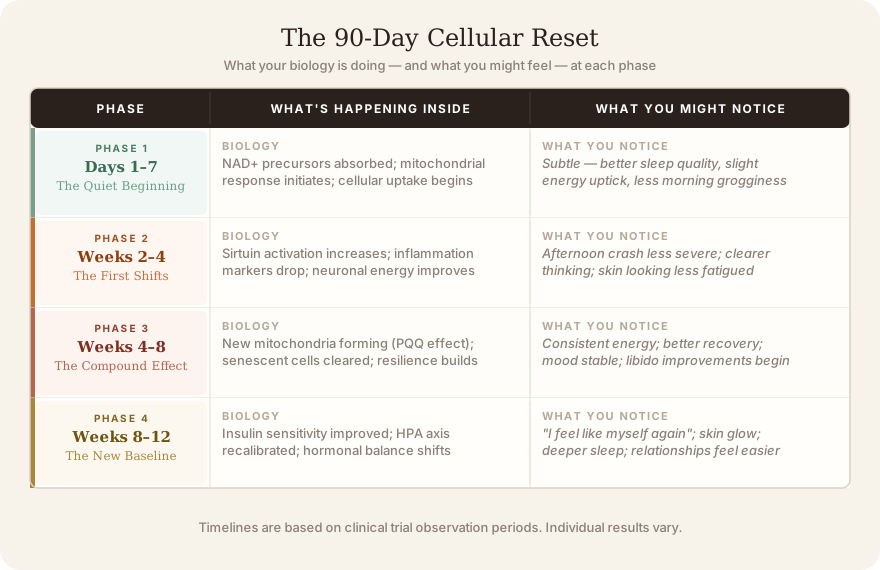
Phase 1: Days 1–7 — The Quiet Beginning
Nothing dramatic happens in the first week. This is the nature of cellular work — and it is the phase where most people who will eventually quit, quit.
What is actually happening: NMN is absorbed through the small intestine, enters cells, and is converted to NAD+. The mitochondria begin responding to the restored substrate. Sirtuin enzymes — the longevity proteins that require NAD+ to function — start to activate, though their effects at this stage are subcellular and not yet perceptible.
What you might notice — or might not: Some people report slightly better sleep quality in the first week. A subtle reduction in morning grogginess. A marginal energy uptick that is easy to dismiss as placebo or coincidence. These are real signals, but they are quiet ones.
The common mistake: Expecting a caffeine-like response. NAD+ restoration is not stimulation — it is structural repair. The correct analogy is not a shot of espresso; it is re-laying the foundation of a building. The building does not immediately look different. But what happens next depends entirely on what was done now.
Phase 2: Weeks 2–4 — The First Shifts
This is where the biology begins to surface as lived experience.
Sirtuin activation is now measurable in the cellular environment. SIRT1 and SIRT3 — the longevity proteins responsible for regulating stress response, metabolism, and inflammation — are operating more efficiently. Inflammatory cytokines that had accumulated through chronic stress and cellular dysfunction begin to decline.
The neurological effects become more apparent: improved mitochondrial energy metabolism in neurons translates to clearer thinking, better word retrieval, and more sustained attention. The afternoon crash — the reliable 3pm collapse that coffee had been masking — becomes less severe, then less predictable.
Skin, which has been quietly undergoing its own cellular renewal, may begin to look less fatigued. The dullness that builds from accumulated stress and inflammation can start to lift — not from a topical product addressing the surface, but from the biology restoring from within.
"The afternoon crash stopped being the defining feature of my day around week three. I did not realise how much I had normalised it until it was gone." — ELUMÉ customer observation
Tip: This is the ideal time to take photographs. The changes in weeks 2–4 are often more visible in retrospect than they are in real time. What looks subtle now can be striking at week 12.
Phase 3: Weeks 4–8 — The Compound Effect
This is the transformation zone — the period where chronic fatigue studies, cognitive trials, and metabolic research consistently document significant change.
What is happening at the cellular level is now genuinely structural. PQQ — paired with NMN+ in the ELUMÉ formulation — has been driving mitochondrial biogenesis: the actual creation of new mitochondria within cells. This is not restoration of existing capacity; it is the addition of new energy-producing infrastructure.
For those following the Longevity Ritual protocol, the RESET phase (days 1–5, using fisetin, quercetin, and apigenin) will have cleared a significant burden of senescent cells — the dysfunctional cells that leak inflammatory signals and actively deplete NAD+ in neighbouring tissue. The cellular environment that NMN+ is now restoring is meaningfully different from what it was on day one.
What people consistently report at this stage:
- Energy: Consistent levels throughout the day, rather than peaks and valleys. Exercise tolerance improves. Recovery from physical exertion is faster.
- Cognition: Focus holds for longer. Complex tasks feel less effortful. Mental endurance — the ability to sustain concentration through a long afternoon — returns.
- Mood: Emotional reactivity decreases. The buffer between stimulus and response — the pause before reacting — feels wider. Situations that previously felt overwhelming become more manageable.
- Sexual health: NAD+-dependent improvements in nitric oxide production and testosterone synthesis become perceptible. Libido and energy for intimacy often improve during this phase.
The 2024 systematic review (Gindri et al., American Journal of Physiology: Endocrinology and Metabolism) documented significant improvements in fatigue, anxiety, and insulin sensitivity in the 4–8 week window across multiple trial designs. This is the phase the research was built around.
Phase 4: Weeks 8–12 — The New Baseline
By week eight, the changes have compounded into something that is no longer incremental — it is integrative.
Cellular metabolism has been optimised across multiple pathways simultaneously. Insulin sensitivity has improved, with implications for sustained energy, hormonal balance, and metabolic health. The HPA axis — the central stress-response system regulated in part by NAD+-dependent sirtuins — has recalibrated toward greater resilience.
What the clinical data describes as "quality of life improvement" translates, in lived experience, to something harder to quantify but immediately recognisable:
"I feel like myself again" — the phrase that appears, unprompted, in customer accounts and clinical patient notes with striking consistency.
What this looks like in practice:
- Sleep that is deeper and more restorative — not just longer, but qualitatively different.
- Skin with visible glow and improved texture — the downstream effect of restored collagen and elastin maintenance through sirtuin activity.
- Relationships that feel easier — because patience, emotional availability, and energy for connection have returned.
- A sense of physical resilience that means illness, stress, and exertion leave less of a mark.
This is not a temporary lift. It is a new baseline — a reset of the cellular environment that, maintained consistently, continues to compound.
The research behind the timeline
The 90-day framework maps directly onto the clinical data:
- Chronic fatigue: Significant improvements typically observed at weeks 4–8 in NAD+ precursor trials.
- Cognitive function: Memory and focus benefits measurable by weeks 6–8 in neurological studies.
- Metabolic markers: Insulin sensitivity changes detectable around weeks 4–6.
- Skin turnover: Full epidermal cell cycle is approximately 28 days; visible changes typically emerge at weeks 6–8.
The 2024 Gindri et al. systematic review synthesised human clinical data across fatigue, anxiety, sleep quality, insulin sensitivity, and quality of life — finding consistent, well-tolerated improvements across all domains. The observation periods in those trials were 8–12 weeks. The results were not accidental. They were the product of giving cellular biology the time it actually requires.
ELUMÉ, designed for the long commitment
NMN+ 99.9 — daily NAD+ restoration
Built on Uthever NMN at verified 99.9% assay purity, paired with trans-resveratrol (SIRT1 activation) and PQQ (mitochondrial biogenesis). Each component is chosen for its mechanistic role across the 90-day timeline — not for immediate effect, but for cumulative, compounding restoration.
The Longevity Ritual — sequenced for maximum impact
The two-step protocol is designed around the biological reality of this timeline. RESET first (days 1–5): fisetin, quercetin, and apigenin clear the senescent cell burden that actively impairs NAD+ restoration. ACTIVATE (days 6–30): NMN+ restores into a cleaner cellular environment — one that can actually receive and use the restored molecule efficiently.
The difference between restoring NAD+ into a senescent-burdened environment and restoring into a cleared one is the difference between replenishing a reservoir with a blocked pipe and replenishing it with the path open.
Commitment is the protocol
The 90-day reset is not a shortcut. It does not work like a stimulant or a topical solution. It works the way biology works — gradually, cumulatively, and then all at once.
The people who see the most significant results are not those who take more. They are those who take consistently, who trust a timeline grounded in mechanism, and who understand that the changes happening in week one — invisible as they are — are what make week twelve possible.
Ageing is a dial, not a switch. And consistency is the hand that turns it.
Begin your 90-day reset with ELUMÉ™ NMN+ 99.9 or the complete Longevity Ritual.
This article is for educational purposes only and does not constitute medical advice. ELUMÉ supplements are health supplements, not medicines, and are not intended to diagnose, treat, cure, or prevent any disease. Always consult a qualified healthcare professional before starting any new supplement protocol — especially if you are pregnant or breastfeeding, taking medication, or managing a medical condition. Use only as directed.